Published on November 6, 2026
Easy Rather Than Best: How Bacteria Reinvent the Same Chemical Weapon
🇮🇹 Leggi in Italiano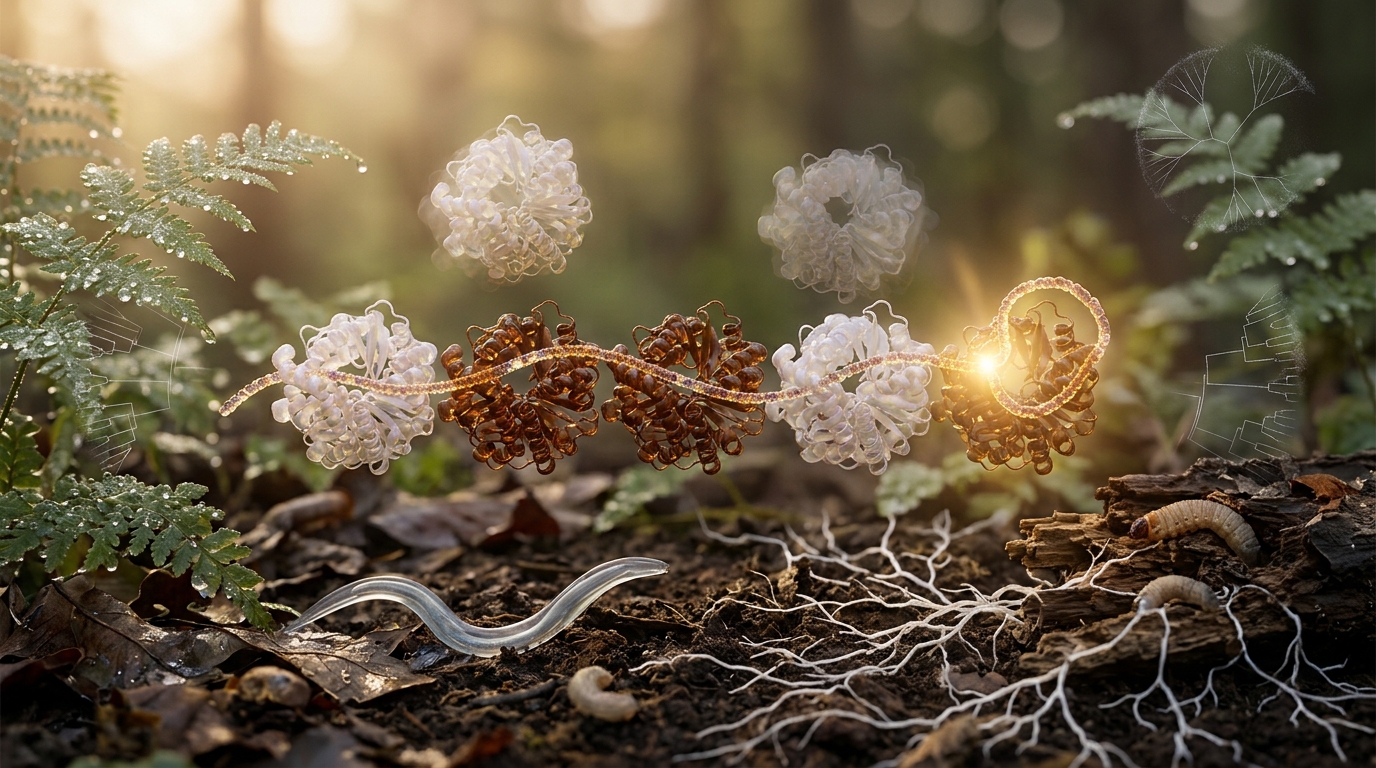
Some of medicine’s most important drugs — penicillin, vancomycin, daptomycin — aren’t made the way most proteins are. They’re built by big enzymes that work like production lines: each station grabs one chemical building block and adds it to a growing chain, so swapping a station changes the final product. That modularity makes these enzymes attractive to drug engineers, and it also creates an awkward problem: the genes encoding them exchange parts constantly, and every exchange creates new chemistry while overwriting the record of what came before. For years that left an unanswerable question: are the molecules nature produces the ones that work best, or just the ones that were easy to stumble into? A study published on October 21, 2026, in Nature Ecology & Evolution by Sebastian Kaiser, Helge Bode, Georg Hochberg, and colleagues in Marburg went looking.
They picked a system small enough to reconstruct completely: the GameXPeptides, insect-killing molecules made by bacteria that ride inside nematode worms and are released when the worm invades a larva. Their production line, GxpS, has just five stations. Using phylogenetic methods built to tolerate part-swapping across fifty-four related genes, the team reconstructed the family’s history and turned up forty-nine distinct molecules. Importantly, they also rebuilt the ancestral gene, reassembling roughly fifteen thousand DNA letters and expressing the result in a laboratory strain. The resurrected enzyme settled the chronology: several of the same molecules had been invented more than once, on lineages that had already separated.
So why does evolution keep arriving at the same answers? Not for one reason, but three. Selection is clearly at work, since the variants differ in how efficiently they kill different insects, and chance plays its part too. The third is the intriguing one, which the authors call recombination bias: swapping requires the two stretches of DNA to resemble each other closely enough to pair up, so the realistic options narrow to a few near-identical modules. What looks like convergence on the best solution may be convergence on the available one. That distinction matters commercially as much as intellectually: a catalogue of natural products is not a ranking of what works, and these lines could in principle deliver far more chemistry than evolution has sampled. Unfortunately the case rests on one enzyme family, with eight molecules tested against four insect species, and the contribution of chance is inferred from recombination patterns rather than measured.
Which leaves the questions worth following: whether the same three forces govern the enzyme families behind our antibiotics, and whether this constraint can be engineered around in the laboratory, reaching molecules nature never tried.
Source: Kaiser S, Shahmohammadi N, Goel TSM, et al. Drift, selection and recombination bias drive the evolution of a non-ribosomal peptide. Nature Ecology & Evolution 2026. DOI: 10.1038/s41559-026-03214-y (open access)
Topics